

Why Marketing Feels Hard to Prove: When It’s Seen as a Cost, Not an Investment
Marketing feels hard to prove when leadership sees it as a cost to manage, not an investment in growth. We uncover how the fix is better alignment, clearer reporting, stronger strategy, and a more commercial way of explaining marketing’s contribution.


Marketing managers sit in one of the most awkward seats in a business. They are expected to drive growth, support sales, improve lead quality, strengthen brand perception, and help the business stand out, then explain all of it in a way leadership finds commercially convincing.
That gets difficult fast when nobody is fully aligned on what marketing is there to do, how it should be measured, or how long results should take to show.
You walk into the meeting thinking you are there to review progress, and five minutes later it feels more like you are in a witness box defending your existence.
That is the tension at the centre of a lot of marketing roles. Being asked to justify marketing over and over again is stressful, exhausting and quietly demoralising. The work may be moving in the right direction, but the conversation still gets hijacked by sceptical questions like: “What are we actually getting from this?”, “Why are we still spending here?”, and the all-time favourite, “But can you prove this is driving revenue?”
The issue is often not that marketing is not working, but that the business has not built a clear, trusted link between marketing activity and business results. When that link is weak, trust drops, scrutiny rises, and marketing starts getting treated like a cost to control rather than an investment expected to drive growth.
The good news is that this is fixable.
Why marketing gets treated like a cost instead of an investment
At the centre of this issue is a simple problem: there is no clear, trusted link between marketing and business outcomes.
Marketing activity is happening, but the role of that activity, the goals behind it, and the way it should be judged are often not clearly agreed. When that link feels weak, marketing becomes easier to question and harder to back.
That uncertainty affects everything: how leadership responds, how budgets are viewed, and how much confidence sits around the marketing function.
Here are the main reasons it happens.
1. No clear agreement on what marketing is meant to do
One of the biggest reasons marketing gets treated like a cost is that many businesses never properly agree on what it is there to achieve.
Leadership may want marketing to generate immediate leads, strengthen brand, improve retention, support sales conversations, sharpen positioning, and contribute to revenue growth all at once. That leaves marketing being judged against a broad mix of expectations instead of a clear brief.
Then success gets measured through shifting goalposts. One person wants short-term lead flow. Another wants stronger visibility. Someone else wants clearer proof of pipeline impact. Marketing can be performing well and still look like it is falling short simply because success was never defined properly in the first place.
I’ve had this happen. You leave the room thinking the brief is clear, then walk into the next review meeting and realise everyone was judging success differently. That is when the whole thing starts getting picked apart.
A practical fix is to agree upfront on a one-page marketing success brief before work begins. It should answer Four questions:
- What is marketing expected to influence?
- What are the primary measures of success?
- What is the realistic timeframe?
- What is marketing not responsible for on its own?
A simple template is enough. One page, one agreed version of success. If leadership and marketing cannot sign off on the same definition of success, the problem starts before the work even does.
For example:
- Business goal: increase qualified leads in Auckland
- Marketing role: generate demand and improve enquiry quality
- Success measures: cost per lead, sales-qualified leads, cost per new customer
- Timeframe: 90 days for lead trend, 6 months for customer trend
- Out of scope: closing sales, customer service issues, pricing changes
That one page can save months of confusion later.
And if there is an unrealistic metric in the room that is going to set you up for failure, say so. You are not there just to receive the brief. You are there to help define what success should look like.
2. Reporting does not show business value clearly enough
Marketing teams are rarely short on metrics. What is usually missing is a clear translation of those metrics into business value.
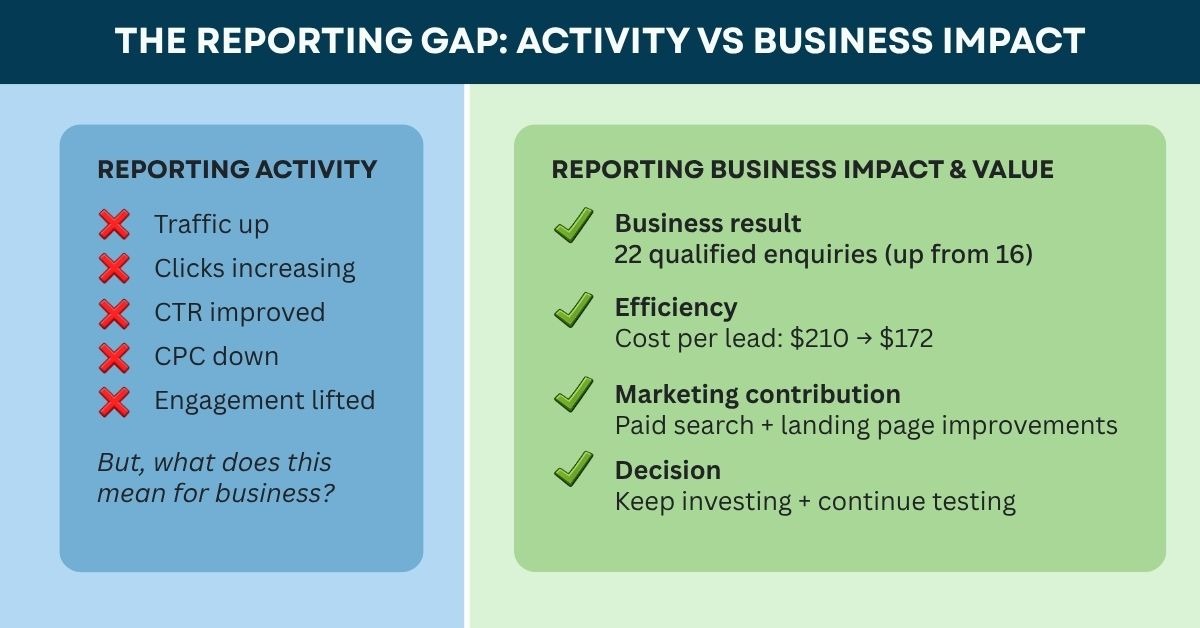
A lot of reporting still focuses on the visible parts of marketing: traffic is up, click-through rate improved, cost per click came down, engagement lifted. However, leadership wants to know whether the business is moving. Is lead quality improving? Is conversion strengthening? Is marketing helping create future revenue?
That is the real gap. When reports do not connect to leads, customers, revenue, sales quality, or growth signals, leadership is left doing too much interpretation. Once a report needs decoding, trust starts to leak out of it.
I’ve seen great results lose momentum and strong campaigns lose support simply because the business impact was buried under channel updates. This is where a lot of marketing reporting quietly dies.
When the commercial story is obvious, the opposite happens. In one client account, Sam at Bloom Healthcare said cost per lead was almost cut in half and conversions increased by 30-40% at a similar level of investment as their previous agency (Bloom Healthcare Case Study). That is much easier for leadership to back when it is framed as a business movement, not just platform activity.
From here, reporting needs to shift from “here’s what happened in marketing” to “here’s what changed in the business, what marketing contributed, and what we should do next.”
Instead of opening with impressions, clicks, and engagement, start with the commercial picture first: leads up 18 percent, cost per lead down 12 percent, and sales-qualified enquiries improving quarter on quarter. Then use channel metrics to explain why that happened.
A strong reporting flow looks something like this:
- Business outcome: 22 sales-qualified enquiries this month, up from 16
- Efficiency measure: cost per lead down from $210 to $172
- Marketing contribution: stronger paid search campaign and a better-performing landing page
- Decision: keep investing in the best-performing search group and keep testing landing page variants
This kind of structure makes reporting more useful because it helps leadership make decisions faster. They do not want a recap of marketing activity. They want to know whether marketing is helping the business grow.
3. Not all marketing works on the same timeline
Marketing also gets misunderstood because different types of activity create value on different timelines.
This is especially true in service businesses, where trust and consideration often do a lot of work before revenue ever shows up, and where short-term ROI can become a misleading judge of longer-term marketing value.
Some activity, like high-intent search campaigns, lead generation offers, and remarketing, sits close to conversion and can show a clearer short-term link to leads or revenue. Other activity is doing a broader job by building awareness, trust, familiarity, preference, and differentiation. That is where a broader measurement lens becomes more useful.
Both matter. They just should not be judged in the same way.
Problems start when direct ROI gets used to judge everything. That is when longer-term marketing starts to look weak on paper, even when it is doing exactly what it is supposed to do.
Lead time matters here too. In many service-based businesses, revenue lags behind the marketing activity that helped create it. If that lag is not understood, marketing gets judged too early and too harshly.
If your business struggles here, split reporting into two views:
That split helps stop brand activity being judged like lead gen, and stops lower-funnel channels being expected to do every job on their own.
I’ve seen this go wrong when a brand campaign gets reviewed after four weeks as if it should behave like a bottom-of-funnel search campaign. Of course it looked weaker. Once the business understands that different work creates value at different speeds, the next challenge is explaining that value in language leadership can actually act on.
4. Marketing and leadership are not speaking the same language
A lot of boardroom credibility gets lost in translation.
Marketing often speaks in channels, campaigns, impressions, click-through rates, and cost per lead. Leadership listens for revenue, growth, margin, customer quality, market position, and return.
Both sides care about value. They just describe it differently.
That disconnect creates friction. Strong work can sound vague when it is explained in language leadership does not naturally use to make decisions.
We see this all the time. A marketing manager gives a solid update, leadership nods along, and yet the room still feels unconvinced because the story never crossed the bridge into a language leadership understands. If marketing cannot explain its value in a language the business recognises and makes decisions, it becomes far more likely to be seen as a cost centre than an investment.
A useful discipline is to translate every major update into three business-facing questions:
- What changed
- Why it matters commercially
- What decision the business should make next
For example, instead of saying “CTR improved and CPC came down,” say “we made it cheaper to attract the right people, which improved efficiency and helped increase qualified enquiries.”
A simple sentence structure is:
We did X to influence Y, which is showing up in Z, so the business decision is A.
For example: “We increased high-intent paid search coverage to influence qualified enquiries, which is now showing up in lower cost per lead and stronger sales-qualified volume, so the best action is to keep investing there.”
5. Strategy isn’t clear
Marketing becomes much harder to trust when there is no clear strategy behind it.
Without strong positioning and differentiation, marketing activity can feel reactive and fragmented, and even well-executed campaigns struggle to prove their value. Businesses often invest heavily in tactics while still being unable to answer the core question: why should customers choose us?
We’ve all had to write ad copy when there’s no obvious differentiation between service providers. Painful.
Strategy needs to come first:
- Who are the specific clients you want
- Why they should choose you
- What channels will we go to market with
Marketing gets easier, becomes effective and credible.
We saw this clearly at Crockers. Before the strategy work, they “didn’t really have a marketing plan” and “weren’t really looking at our funnel.” Once that changed, they saw stronger brand awareness, more leads, and better-quality enquiries coming through (Crockers Group Case study).
Bottom line: Leadership and marketing need to commit to a strategy that sets them apart.

What needs to change
So what needs to change?
If marketing is going to be treated like an investment, the business needs a clearer system for defining success, measuring commercial outcomes, separating short-term performance from longer-term demand building, and reporting results in a way leadership can actually use.
Strong marketing should be easy for leadership to understand and not a constant defensive storytelling battlefield from an exhausted marketing manager. If it’s being asked to prove itself from scratch every month, the system is broken.
Here is a practical framework to fix that.
How to make marketing easier to prove: a 4-step framework
When marketing is clear, it becomes easier to back. The numbers do not need to be perfect for the system to make sense. What matters is that the business can see what marketing is there to do, how it contributes, and what should happen next.
1. Define what the business cares about & create an aligned strategy
Start with asking the important questions of matters most right now for the business. For example:
- Stronger visibility in a new market?
- Is the business in a period of growth or consolidation?
- What is the business looking at in the short & long term to be successful?
- What’s the current business strategy?
With those questions clear, you have a much better understanding of the job your marketing needs to do and how to perfectly form your marketing strategy next so it’s aligned with the business strategy and future plans.
Here’s a couple of questions to ask when forming the marketing strategy:
- How would we position ourselves to accomplish that goal?
- What’s our budget and timeframe?
- Who are we talking to, and what message do we want to get across ie. target market, demographics
- What do they need, and what solutions can we offer?
When that is clear, marketing gets judged against the right brief. Define the scope of marketing, what it’s going to be judged by and how to report on success before you get started.
Expert’s insight: This is the biggest thing to get right. In our experience, it will go wrong eventually if there isn’t agreement between the marketer, leadership and the board on what marketing is supposed to accomplish and how to report on that accomplishment.
Pro tip: This will be one of the most important conversations to have from the start. Get super clear on the business strategy, so your marketing strategy and plans going forward are aligned and based on business needs.
2. Connect marketing activity to revenue outcomes
Once business priorities are clear, marketing needs to connect to them in a way that makes sense for the business.
A good place to start is with a small set of commercial measures leadership already understands:
- Cost per lead (CPL): total marketing cost, including salaries, divided by leads generated. This helps you understand how efficiently marketing is generating opportunities.
- Cost per new customer (CAC): total marketing and sales cost divided by new customers. We prefer this over CPL because It’s a foundational metric for business growth. It gives a view of what it costs to gain a customer.
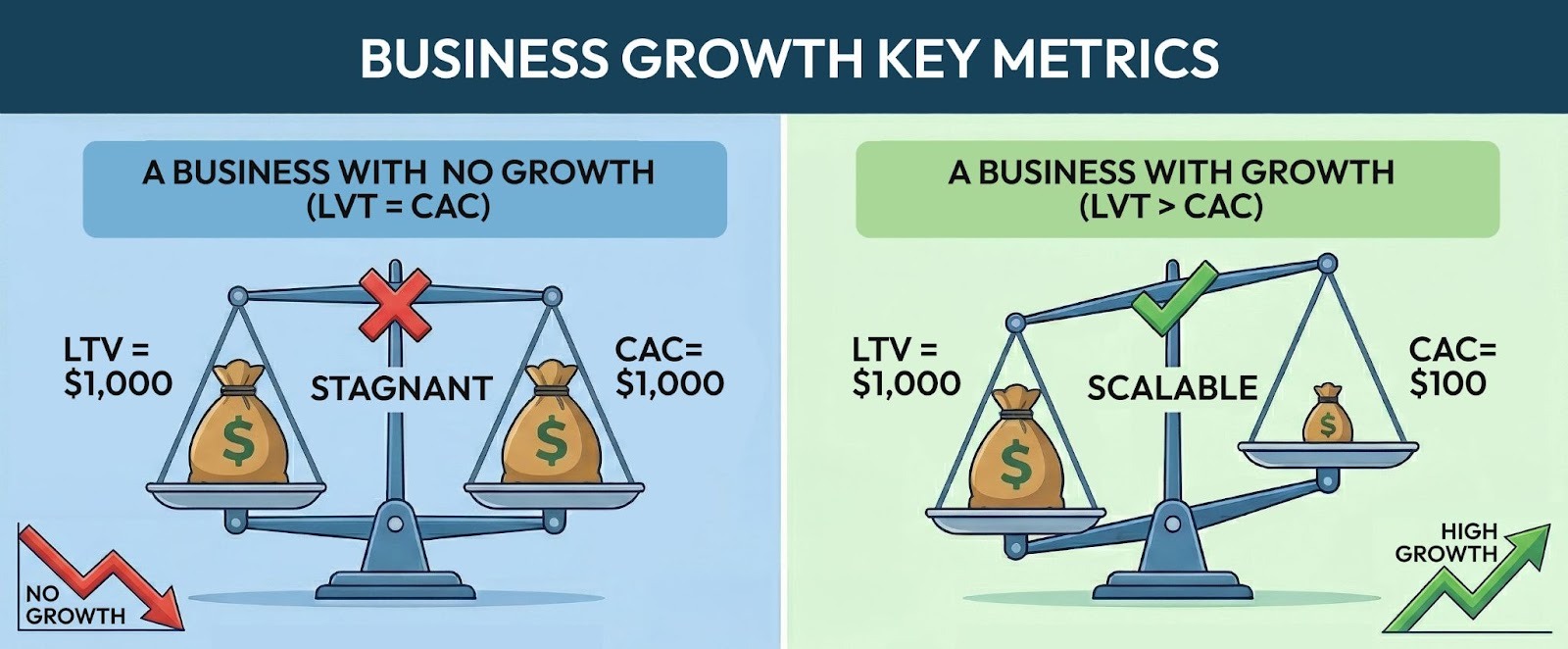
- Average lifetime value (LTV): Average total value per customer. How much the business makes from each customer. Advise reviewing at least the past 12 months to get a baseline.
These three metrics can give you the fundamental understanding of whether or not your business is in a position to grow.
For example, let's say your average lifetime value is $1k per customer. And your cost to acquire a new customer is also $1k.
This business is not in a good way. It won’t grow and if it does grow, it won’t make any money.
Ok, lets play with these numbers, lets say the average lifetime value is $1k per customer and your CAC is $100.
Wait, it costs you $100 to acquire a customer that is worth $1k?!?!? Well, holy crap, now the business can grow! Bearing in mind the costs to service aren’t crazy. For service businesses, this can often sit around 50%.
Pro tip: start with rough commercial measures if that is all you have. A messy but honest view is more valuable than a polished dashboard with no commercial anchor.
3. Simplify reporting to reflect the strategy
More data does not automatically create more credibility. Often it creates more noise.
The strongest reports we’ve seen are rarely the busiest ones. They are the ones that make it easy for leadership to understand what changed, why it matters, and what should happen next.
A simple reporting structure works best:
- The business performance picture first
- The marketing contribution second
- The channel detail third
That means opening with the outcomes that matter most, then using marketing data to explain performance rather than making leadership dig through platform metrics to find the story.
It also means keeping definitions stable over time so results can be compared properly and trusted. For example, if your January report shows 120 leads because every form filled is counted, but February’s report has 80 leads because only those who are deemed qualified enquiries are included, then it will look like performance dropped by a third, even if demand stayed exactly the same.
When creating your reports, start with business outcomes, how marketing contributed, and decisions you need to make. You do not need to rebuild the whole deck to make it more useful.
I’ve seen a 2-page report do more for leadership confidence than a 20-slide deck, simply because it respected the difference between being detailed and being useful.
Pro tip: if your report takes more than a minute to answer “are we moving in the right direction?”, it is probably too complicated. And if your definition of a good lead changes every quarter, trust will move with it.
4. Give leadership a clearer view of what marketing is contributing
At leadership level, the questions are usually simple:
- What is working?
- What is changing?
- What is marketing helping the business achieve?
- Where should we invest next?
A good rule is to finish every leadership update with one recommendation only: keep investing, test further, fix something, or stop.
When marketing can answer those questions clearly, confidence starts to build and marketing managers get more room to lead.
At AJ Hackett, Heather described the work as “hugely productive” because the team could clearly see how digital activity connected to the wider commercial goal of growing direct revenue, not just platform performance in isolation (A J Hackett case study). That is the real win.
Expert’s insight: In terms of lead generation for each branch, there’s no getting around the need for a CRM or Google Sheet or some type of record for the leads that are coming in. We need to collect lead and customer data over time to understand if we’re making an impact on business growth.
Pro tip: end each report with a decision recommendation. Do not stop at reporting what happened. Tell the business what it should keep doing, change, test, or stop.
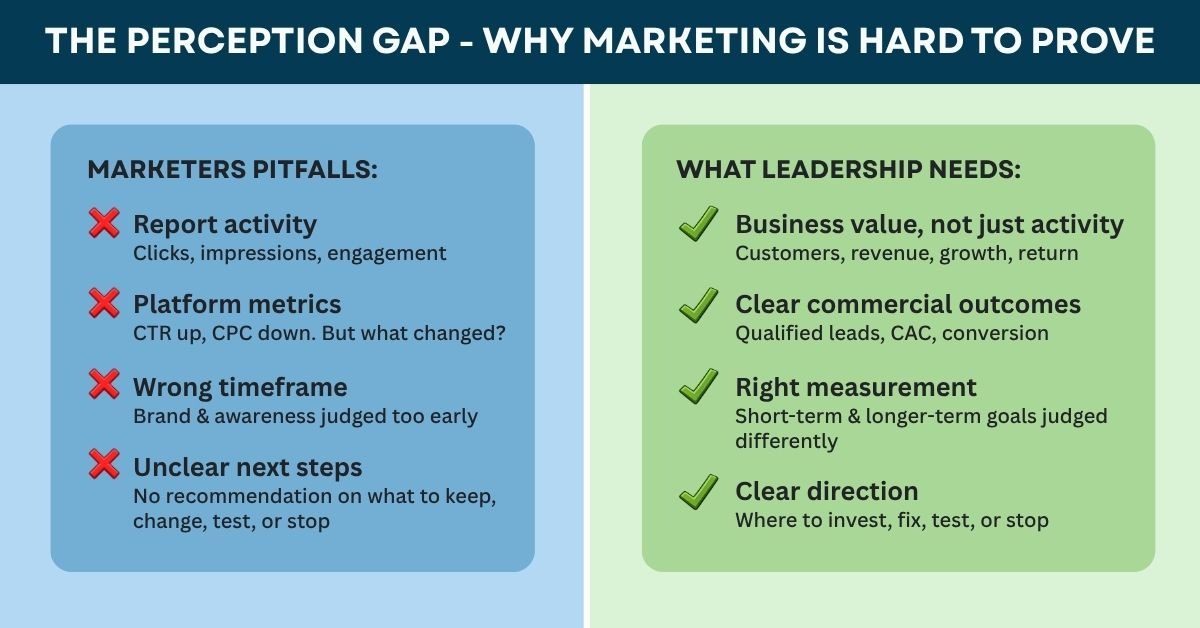
The shift: from defending spend to guiding investment
The most useful shift is mental. To take a step back and critically analyse how your marketing will be viewed. We need to frame the conversation correctly to get marketing treated as an investment in growth rather than a collection of activity.
When that happens, leadership confidence improves, budget discussions become more constructive, and marketing managers spend less time justifying their existence and more time leading.
If leadership can clearly see what marketing is doing for the business, the conversation changes from “prove it” to “how do we build on it?”
Here’s a quick guide for reframing the mindset:
Summary
If marketing feels hard to prove, the issue is often not that marketing is underperforming. It’s just being strategised, measured, reported, and explained in a way leadership can’t use.
Fix that, and a lot of supposedly “hard to prove” marketing starts looking far more credible.
That is where Insight Online fits best. We help businesses connect marketing activity to business results, simplify the reporting story, and build systems marketing managers can confidently stand behind.
Once marketing is seen properly, it stops looking like a cost to control and starts looking like an investment worth backing.
FAQs
Q: Why is marketing often seen as a cost instead of an investment?
A: Marketing is often seen as a cost when its role and contribution are unclear. If leadership cannot see how marketing connects to customers, revenue, and growth, it is easier to question the spend than back it.
Q: How do you prove marketing value to leadership?
A: Start by aligning on what marketing is responsible for, then report on business outcomes first instead of just activity, and explain results in language leadership uses to make decisions. That means leading with things like qualified leads, customer acquisition cost, enquiry quality, pipeline movement, or revenue contribution, then using channel data to explain what influenced the result.
Q: What should be in a marketing report for a CEO or leadership team?
A: A strong leadership report should answer four things quickly: what changed, why it matters commercially, what marketing contributed, and what decision should be made next. Platform metrics can support the story, but they should not lead it.
Q: What metrics matter most when proving marketing performance?
A: That depends on the business model, but useful commercial metrics usually include cost per lead, cost per qualified lead, customer acquisition cost, lead-to-sale conversion rate, pipeline contribution, and lifetime value. The important part is choosing metrics leadership actually uses to make decisions.
Q: What is the difference between short-term and long-term performance reviews in marketing?
A: Not all marketing works the same way or on the same timeline. Short term performance signals highlight existing demand and can show direct return more quickly. Long term growth signals are broader and look at how marketing contributes to growth, including things like demand creation, trust, brand strength, and future revenue. Both matter, but they should not be used interchangeably. If everything gets judged on immediate short-term results, longer-term marketing will almost always look weaker than it really is.
Q: Why do marketing results still get questioned even when performance is improving?
A: Performance alone does not automatically build confidence. If expectations were unclear, the reporting is too channel-heavy, or leadership does not understand the role marketing is playing, even decent results can still feel unconvincing in the room.

Want instant updates when we release new blogs?
Never miss out again - sign up to our newsletter. Get the latest news, resources and marketing tips straight to your inbox. We won’t share your details or spam you. Unsubscribe anytime.