

How to Win in a Complex Marketing World
Marketing has never felt more complex. AI, zero-click search, and less reliable data are hitting marketing managers all at once. Here's a dive into the complexities we face and how to simplify your approach to win in a complex marketing world.


It feels harder because it is harder
It’s 8.47am on a Monday. You open your laptop to six unread reports, a Slack asking why ads underperformed last month, and an email from your CEO: Quick question about AI.
You haven't had coffee yet.
Marketers across the world are navigating the same thing. The digital landscape is in a state of big change. And the expectation that you'd stay on top of it? That didn't change at all.
Francisco, Account Director at Insight Online, comments:
"Every time a new channel arrives, it's the same discussion. People go, 'What do I do?', but it takes the focus away from the basics. I think simplifying is going back to the expectations and what your business actually needs right now."
That's the aim of this article. To highlight some of the factors driving complexity and map out how you can win.
Why does digital marketing feel so complex right now?
The latest State of Marketing report from Hubspot: “61% of marketers say the industry is experiencing its biggest disruption in 20 years.” AI is the main driver but there are several forces combining to drive the complexity. Here are the big three we’re seeing.
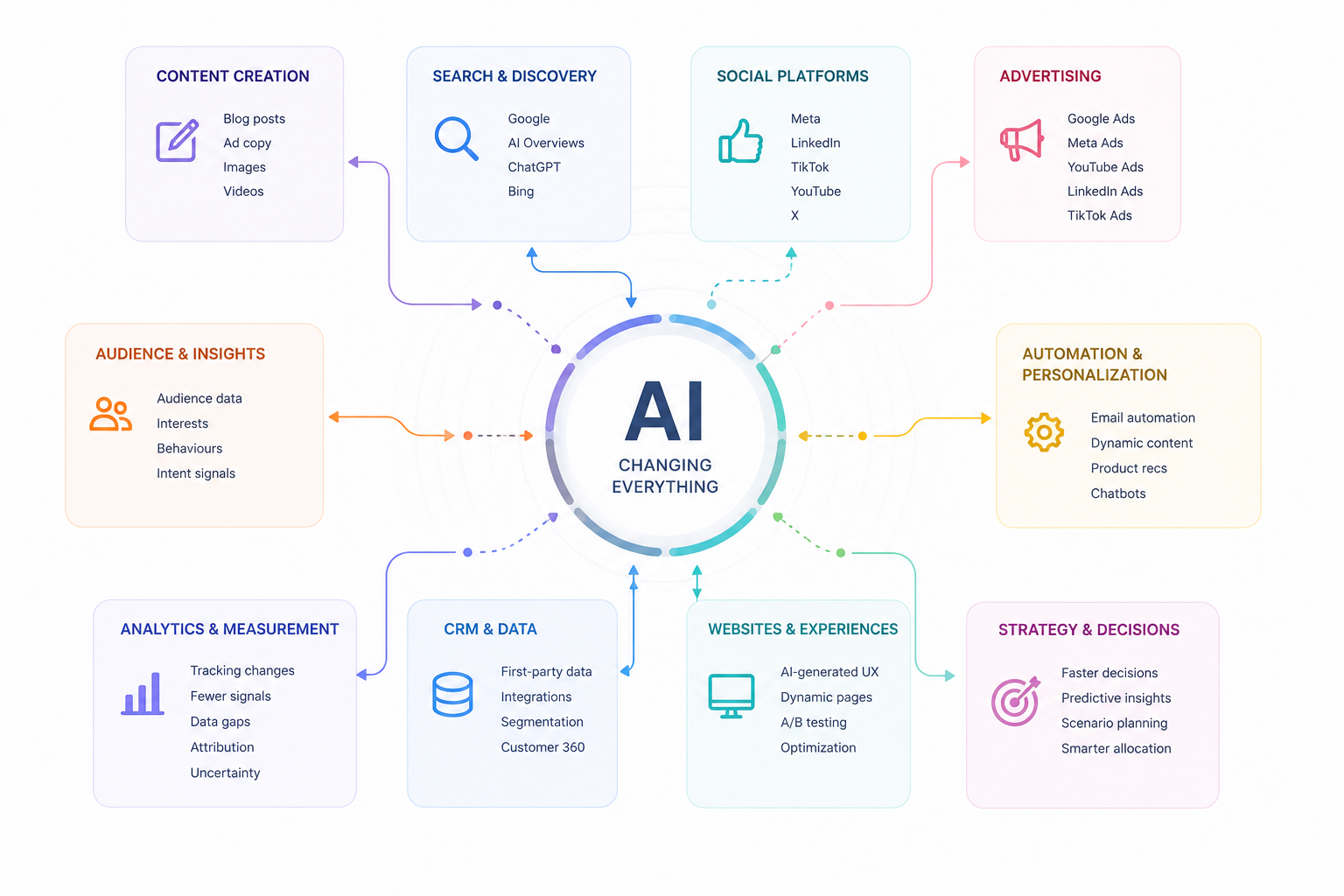
1. AI is changing everything at once
You know why everything feels like it's changing right now? Because it is. As a knowledge worker, the introduction of AI / LLM technology means that every tool that we work with is being updated with it.
The only solace we can give is that, as much as you are struggling with the pace of change, so is everyone else. The pace of AI technology will outpace our best efforts to keep up. The limiter will be how quickly we humans, businesses and organisations will change. And that will take time.
So if you’re struggling to keep up, you’re a sane normal human being. We’re seeing that a couple hours a week dedicated to training can be extremely helpful. At Insight, we’re looking to 10 Past Tomorrow as one of our training providers and we’d highly recommend them.
2. Zero click marketing is happening
Your audience is coming to your website less. Google, YouTube, Meta, LinkedIn, TikTok, and increasingly they’re just asking AI directly and never clicking anywhere at all. A 2024 Zero-click search study found for every 1,000 searches in the US, only around 360 clicks actually reach a website. Rand Fishkin at SparkToro, who coined the zero click term, put it plainly:
“60% of marketers say their top goal for the next 12 months is ‘increasing traffic.’ And 59% say their primary KPI is… also traffic. To all those folks, I say: you’re about to have a terrible, horrible, no-good year. The Internet is sending less traffic. Period. - Rand Fishkin, SparkToro
Brand building is hugely important, it always has been. But it’s coming back into the limelight at a time when one of the major metrics we’re using, website traffic, will be increasingly unusable. This is further compounded by our next factor.

3. Privacy laws impacting analytics and tracking
Privacy law changes, ad blockers, AI campaigns running as black boxes. The data was never perfect, but categorically, we’re seeing less data to make decisions on. That means reports with fewer and fewer numbers, campaigns generating less traffic on paper.
We can recover and improve data. But overall, we’ve got to be thinking about how we’ll analyse campaigns when we simply won’t “see” as much activity. Our take? It’s pushing us towards having statistically significant data as one signal of a few in order for us to guide campaign strategy.
Helene, our senior Analytics expert, commented as we were discussing reporting:
"The businesses navigating this well have stopped asking 'are these numbers exactly right?' and started asking 'what can our data actually do for us?’”
The things that marketing managers used to rely on, to…know if you were winning; our tools, our KPIs and our tracking have all gotten less reliable at the same time.

What this is doing to marketing managers
When all factors hit at once, the natural response is to try and keep up. Explain more. More channels, more campaigns, more reporting. It feels like the right move.
At Insight, we’re not immune. We know what it's like when there’s so much change going on that it wraps you up into a tight ball of anxiety. The feeling that you're falling behind, the feeling that you're not quite good enough.
Wyn, our eCommerce expert, says it’s the undertone of almost every client conversation he has. He doesn't even have to ask directly. A simple "how you going?" is enough. "Frantic." "Not enough time in the day." "I'm doing so much right now."
You’re working harder than ever. Yet you walk into the leadership meeting already on the back foot. The results are there but you can’t quite explain them.
How do we win in this new world?
Many people are asking:
- What’s the AI tool we need to learn?
- What’s the new channel we need to be on?
- How can we make our tracking bullet proof?
But we would argue these are the wrong questions. When complexity increases, you need to simplify your thinking into a blade to cut through it.
Better questions:
- What's our one priority right now, and why?
- What are we choosing not to do, and why?
- What will we learn from this in the next 90 days?
The key to answering these questions well goes back to really understanding what your marketing is supposed to be doing for your organisation. They're not, by themselves, easy questions to answer but if you can answer them you can defend yourself to any board.
1. What's our one priority right now and why?
Answering this as a marketer requires you to really focus on understanding what the organisation's goals are at this particular point in time and how marketing can help to achieve them.
Internally it's also understanding that you cannot do everything at once so there must be a focus.
Wyn recently pulled a report from the client’s CRM showing which channels were driving real customers. Amazing clarity resulting in one priority: Put more money into Google Ads until leads are maximised. Not go chasing more channels
For many marketers, focus is a luxury, not the reality. You get so many things thrown at you. But, at the back of your mind, we’re sure you can think of one thing that if you executed on, your board or boss would be exceptionally pleased.
2. What are we choosing not to do and why?
This question is your defence against all the people that are saying things like,
"Oh why don't you do TikTok” or
“Oh I saw this thing on YouTube" or
“We need to see more video”.
We want this to be your bulwark against the comments that everybody feels they need to make about your marketing and your strategy and your initiatives.
It says to people: Yes thank you for your feedback. It has been considered and here is the proof of that. Use this question as a tool to help put a lot of these casual remarks to rest.
3. What will we learn from this in the next 90 days?
Marketing is a future-facing activity and if we were to really confront the truth of what marketing strategies and campaigns are, it's that they are well-informed bets on what we think will work. Crucially we don't actually know if they will work. If we knew marketing would be a lot easier!
Therefore we, as marketers, need to gauge progress because we understand that some of these campaigns and experiments will fail. That's the truth. But from every failure and indeed from every success we can learn. We can make and show progress.
Tighter campaigns are also easier to explain to leadership. When a campaign has one clear objective and you can show what it taught you, the conversation in the boardroom changes. You stop defending activity and start discussing decisions. That's a very different meeting.

What this looks like in practice
Olibo Optometrists - What they chose not to do
Olibo Group runs 5 optometrist practices across New Zealand, each with its own brand, regional audience, and separate website. When Insight Online came on board they had a botched CMS migration that had tanked traffic, and no foundation worth building on.
Our focus was simple: Do they show up on Google for all five locations, and do they have good reviews? We went back to basics and tackled local SEO, first and foremost. The result: growth in online appointment bookings across all five practices.
We began with a full technical SEO audit across all five sites. The temptation with a multi-site setup is to jump straight into content, but you have to make sure the framework is crawlable and indexable, and resolve the structural issues, before any content investment. We fixed the foundation first, then built from there. - Alfonso, SEO Strategist
Primepac NZ - Weaponising your learnings
Primepac is a New Zealand packaging supplier in a competitive B2B market. Their agency relationship did not lead and just did what they were told. Budget was heavily skewed toward brand campaigns with no strategic logic, and results were hard to defend. Dolly Sangduan, who leads marketing at Primepac, put it plainly:
"We need someone, a partner who we can rely on that actually knows what they're doing, say it how it is, proactively think and plan and tell us what we need to do or focus on." - Dolly Sangduan, Primepac NZ, Case Study
Sometimes removing chaos is simply starting over. We rebuilt their Google Ads, proved Microsoft Ads works, then simply scaled both. What also helped was automating their clunky data processes, so what manually took hours every night became a few minutes in the background.
Google Ads revenue grew 62% over 2 years.
Closing thoughts
If you're a marketing manager reading this at the end of a long week, feeling like you're juggling too much and proving too little, please know you’re not failing. That’s what happens when a complex environment meets a reactive strategy.
The marketers that are going to succeed in this world are doing fewer things with more conviction. Carefully assembling their strategies, critically assessing each tactic. Enough time and budget to actually learn something.
That's how you win in a complex world.
Ready to cut through the complexity?
If your marketing is spread too thin and your reports are full of numbers you can’t explain to your CEO, that’s exactly the kind of problem we untangle. Strategy, execution, reporting that means something. Let’s work out where to focus first. Give us a call anytime.
FAQs
Isn’t focusing on one channel risky?
No, here is what is actually risky: spreading yourself and your budget so thin that you burn out and there's no clear learning or progress from your marketing campaigns. Focusing on one channel is not inherently risky. It just has to be clear on what the outcomes are and what the learnings will be (Question 3 above).
What if my CEO and I disagree on the priority?
This is going to happen and it helps to be prepared. It involves discussing what marketing is meant to be doing for the organisation and what your responsibilities are. If there’s still no alignment, then it’s the dealer's choice. My take? Execute the CEO's priority well, document what you'd have done differently, and use the 90-day results to inform the next conversation. This is a conversation to have early and as often as needed.
Should I still invest in server side tracking and better analytics?
Yes but as infrastructure, not strategy. The three questions come first; server-side tracking is how you measure whether you're winning on the priority you've chosen. Don't let the absence of perfect tracking stop you from acting, and don't let the presence of good tracking become a substitute for choosing.

Want instant updates when we release new blogs?
Never miss out again - sign up to our newsletter. Get the latest news, resources and marketing tips straight to your inbox. We won’t share your details or spam you. Unsubscribe anytime.