

Critical SEO Metrics for Decision Makers
Learn how to effectively measure SEO performance and understand its impact on your business. Discover essential metrics and practical tips to make data-driven decisions and optimize your SEO strategy.


How the heck do you measure SEO? There are hundreds of SEO metrics, more than you can shake a stick at. How can you, as a decision maker, understand whether your investment is returning business value? That's what we'll be chatting about in this post.
One of the biggest problems is that there are so many SEO metrics we could be looking at. And for different people in different roles, they are useful. However, for those of you that are sitting at a strategic level, you don't need them all. In fact, they confuse rather than enlighten. So let's set some parameters for how we'll choose our metrics:
- Metrics inform us at a strategic level - That immediately cuts out the majority of metrics. Our focus is on whether SEO is returning business value, how it adds to our marketing mix and how it shows our position in the market.
- Metrics inform us of progress over time - SEO is a long term game and so dates, time, seasonality will be needed to gauge progress and give context.
- Metrics can be tied back to business value - As a decision maker, I'm constantly thinking about what I can tweak, adjust and monitor to increase business value. So, in terms of SEO, what metrics can help me make those decisions?
- Metrics can be communicated easily - Understanding it myself is one thing, but what if I need to explain to my board, other stakeholders and team members? The metrics need to be clear for communication to a variety of stakeholders.
Ok, with those parameters in place, let's look at some options. We’re going to be looking at:
- Overall organic impressions from Google Search Console
- Organic clicks from Google Search Console
- Organic traffic from Google Analytics
- Leads/Revenue from Google Analytics
- Keyword Rankings from your choice of rank tracking software
Side note: You're probably already doing this, but it bears a mention. There are many marketing channels we could invest in. So I'm sure that you've done your due diligence and know there are people searching for your brand and/or your services. In short, that SEO is a good investment on paper. If you're unsure how to do this, check out our article about How to know if SEO is right for you.
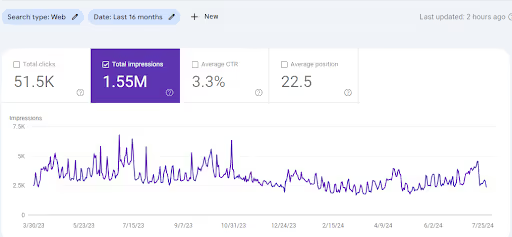
Overall organic impressions
Source: Google Search Console > Performance > Search Results
What is it? This shows the number of times your website has appeared in search results over a given time period. It can be used as an indicator of:
- Brand health and growth
- Visibility for your brand, products and services
- Customer demand for your products/services
Potential Insights
- Search demand over time is often a great proxy for showing seasonality
- Search impressions for your brand over time are a strong indicator of brand growth
Hot Tip
- Google Search Console only lets you look back 16 months. So if you find this information useful, I'd highly recommend downloading this data to a Google Sheet so you can get longer time frames.
Overall organic clicks
Source: Google Search Console
Location: Performance > Search Results
What is it? This shows the number of times your website was clicked on when it appeared in the organic search results. If the impressions (shown above) shows how visible you are, clicks would be a good indication of preference i.e. people are seeing you and then CHOOSING to click on you.
- Brand preference over time
- Traffic to your website from organic search (Helps to correlate GA4 traffic)

Potential Insights
- If impressions shows you overall demand and visibility, matching it with clicks can show you what percentage of people are choosing you over time
- This becomes especially interesting if demand is rising or falling but clicks are staying stable

Website Metrics
Organic Traffic
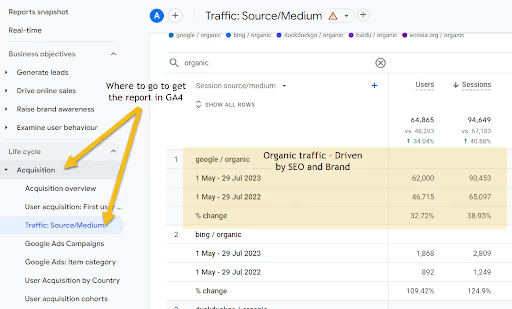
Source: Google Analytics 4 > LifeCycle > Acquisition > Traffic
What is it? Google Analytics 4 (GA4) is an analytics tool you put on your website to see where people came from and what people are doing on your site.
The traffic report provides an understanding of how people are getting to your website. You're looking for organic or organic search traffic source. Again, year on year, it can give a strong indication of how SEO is growing your website traffic.
Potential Insights
- Reviewing this year on year is a very direct measure of the value SEO could be bringing. If I could only choose one metric, I would likely choose this one.
- Reviewing your organic search traffic alongside your other traffic channels can give you a good sense of the value of the traffic. Particularly if you're paying for Google Ads or doing a lot of social media.
Hot Tips
- Handy thing to do is to pull up your marketing calendar or notes from the past year alongside this graph when you're reviewing the numbers. It can provide a lot of context for what's happening.
- Downloading the data into Excel or Sheets or Data Studio would allow you to create graphs that just focus on organic search traffic over time.
Organic Leads/Revenue
Source: Google Analytics 4 > Lifecycle > Acquisition > Traffic (Same place as above, different column)
What is it? This is another strong metric for the most direct information about how your organic search is performing. Although arguably, how people are converting on your website would introduce a whole host of different factors i.e. cost, brand, competition, website ux, etc.
But still, if your website is generating revenue or leads, it's powerful to know how much revenue or how many leads organic search is generating.
In many cases, organic search will drive higher traffic numbers, but this traffic may convert at a lower rate which matches the channel. It'll be a big traffic driver but not necessarily the highest converting channel. It's likely Google Ads or Email taking those spots.

Potential Insights
- Comparing how well each channel is turning traffic into leads or revenue can be quite useful in determining your marketing mix.
- SEO is useful for getting large traffic numbers but sometimes drags behind performance channels in terms of conversion rate. (Although it can be made up by volume)
Hot Tips
- Make sure leads or revenue tracking is set up properly in your analytics.
- Don't be a noob and only judge your marketing channels by revenue or lead numbers. Each channel has a different job and are good at different things.
Keyword Rankings
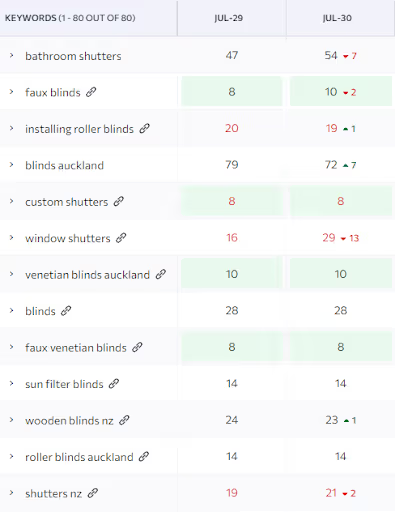
Source: SEM Rush/Ahrefs/SE Ranking > Rank Tracking
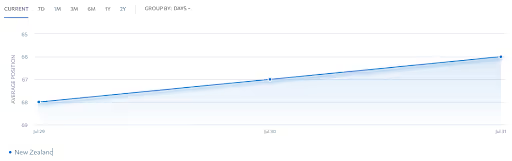
What is it? Did you know that SEO doesn't increase traffic per se? SEO or Search Engine Optimisation is about increasing the ranking of keywords relevant to your organisation. So, over time, what happens is that your website appears further and further up the page as SEO builds up your website authority.

So understanding these rankings and tracking your keyword ranks over time is what we call rank tracking. If you have an agency, they will do this for you. They will likely track 100 or more keywords and monitor over time what's happening to your rankings.
As your rankings increase, people are most likely to click on them to visit your website. In a perfect world, you'd rank in the top 3 for the majority of your targeted keywords.
Potential Insights
- High rankings should equal more traffic. But say that's not occuring? You've got great rankings but the traffic isn't there. It points to a bunch of other issues:some text
- Poor brand recognition compared to your competitors
- Ranking for keywords with little search volume
- Poor title tag and meta-descriptions - Essentially, the ad copy for your web page
- In these tools you can break up your keywords into niches or categories. For example, I might have a group of Google Ads keywords for my agency. Breaking it down a little like this, can help you to better understand how you're performing in specific categories.
Tips
- It's generally easy to insert your competitors in here as well so you can see how much market share you're getting compared to them
Final thoughts
All the metrics I've mentioned above can be reduced to graphs on one Looker Studio template. At a glance, it can give powerful insight into whether or not SEO is producing value for your business.
And that's important if you're investing $1k to $5k on SEO and potentially content and creativity. We need to have some idea of whether it's paying off.
Additionally, the use of data from three different sources will give us some form of correlation into whether it's working as a whole.
SEO is a tremendously powerful marketing channel. But too often, performance is obfuscated or misunderstood. Start getting a really clear idea of what's working and what isn't.
What did I miss? Is there anything you prefer to the above?? Email or DM me to discuss!

Want instant updates when we release new blogs?
Never miss out again - sign up to our newsletter. Get the latest news, resources and marketing tips straight to your inbox. We won’t share your details or spam you. Unsubscribe anytime.